
How to Test a Pickleball Paddle Before Buying - 2026 Guide
You have spent two weeks reading reviews, watching paddle comparison videos, and refreshing spec sheets at 11pm. You have narrowed it down to three paddles. They all look great on paper. So you buy one, it turns up, you take it down the local courts, and within twenty minutes you can feel it: the balance is wrong for your swing, the handle is half a centimetre too short, and that "huge sweet spot" everyone raved about feels like a postage stamp to you. Sound familiar? Here is the honest truth we tell every player who walks into our Epping store: a spec sheet cannot tell you how a paddle feels in your hand. Only hitting it can. This guide walks you through exactly how to test a pickleball paddle before buying, what to feel for, and why guessing from numbers is the slowest, most expensive way to find the right one.
Table of Contents
Why specs only take you so far
Specs are useful. Core thickness, weight, shape and surface tell you roughly what a paddle is built to do, and they are a good way to build a shortlist. But after years of fitting players, we can tell you this: two paddles with identical specs on paper can feel like completely different tools in your hand. Swing weight, where the mass sits, how the handle fills your palm, how much the face buzzes on contact, how it sounds, how forgiving it really feels when you mishit under pressure. None of that comes through on a product page. The numbers narrow it down. Your hand makes the final call. That is the entire reason we built a demo court instead of just stacking paddles on a shelf and hoping you pick right.
What to actually feel for in a paddle
When you pick up a paddle to test it, you are not just checking if you like the colour. There are six things that decide whether a paddle works for you, and most of them never show up cleanly on a spec sheet. Here is what to pay attention to, and what each one actually changes in your game.
Weight and balance
Weight is the first thing you notice and the thing that affects everything else. A heavier paddle (around 8.3oz and up) gives you more power and stability against hard shots, but it tires your arm faster and slows your hands at the net. A lighter paddle is quicker and easier on the elbow but gives away some power. Balance matters just as much as the number on the scale. A head-heavy paddle swings like it wants to drive the ball, which suits baseline players. A head-light or balanced paddle feels nimble in your hand, which suits players who live at the kitchen line and need fast hands for volleys. Two paddles can weigh the same and feel completely different because of where that weight sits.
Sweet spot size
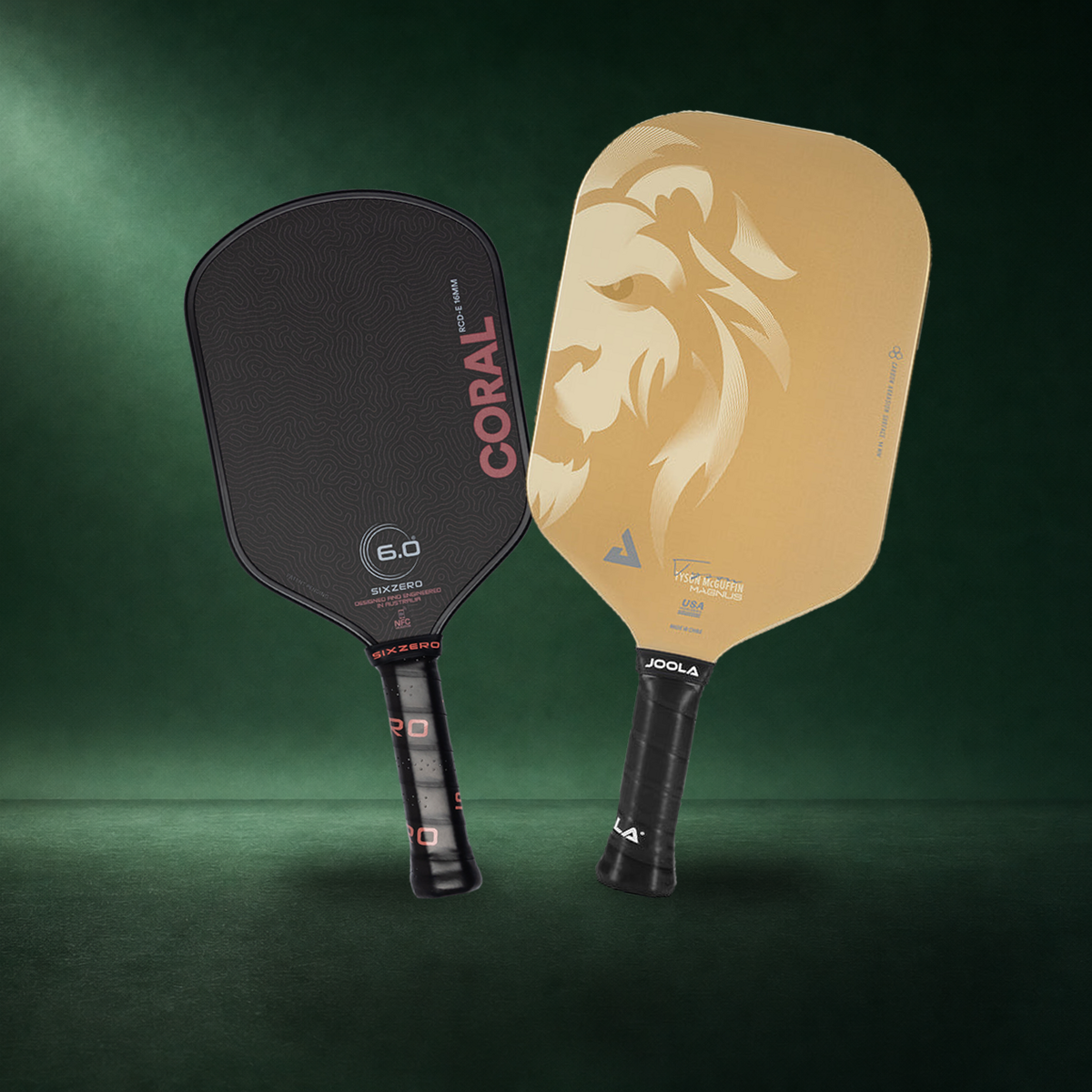
The sweet spot is the area on the face that gives you clean, consistent contact. Hit it and the ball goes where you aimed. Miss it and you get a dead, off-centre response that floats long or dumps into the net. Elongated paddles like the Six Zero Coral (16mm) Elongated Paddle ($275) trade a little forgiveness for extra reach and leverage, which experienced players love. Wider, more standard-shaped paddles usually offer a more forgiving sweet spot, which is friendlier when you are still developing consistency. You cannot feel a sweet spot from a photo. You feel it by mishitting a few balls on purpose and noticing how the paddle responds when you do not catch it perfectly.

Pop and power
Pop is the instant, lively response off the face, the feeling of the ball springing off the paddle. Some players love a poppy paddle for putaways and quick hands battles. Others find too much pop makes the paddle hard to control on soft dinks and resets, where you actually want the ball to die at your opponent's feet. Thinner cores, like the 14mm JOOLA Tyson McGuffin Magnus CAS (14mm) ($209.95), tend to feel poppier and more powerful, while thicker 16mm cores tend to feel softer and more controlled. There is no "best" here, only what matches how you play. Test it by hitting a hard drive and then immediately a soft dink, and ask yourself which one the paddle made easier.

Spin and surface grip
Spin comes from the texture of the paddle face biting the ball as it brushes across. A grippier surface lets you generate more topspin on drives and more bite on slices and serves. To test it, hit a few topspin drives and a couple of slice shots and watch the ball. Does it dip and dive the way you want, or does it sail flat? Run your thumb across the face too. You can feel the difference between a slick surface and a gritty, textured one. Just remember that all surfaces wear down over time, so what matters is how it grips today and whether it gives you the shape you are looking for on your shots.
Hand feel, vibration and sound
This is the most personal one and the hardest to fake. Some paddles transmit a sharp buzz into your hand on contact, which over a long session can bother your elbow and wrist. Others feel plush and muted, with the vibration soaked up before it reaches you. Neither is wrong, but you will have a strong preference once you feel both back to back. Sound is part of this too. Some paddles have a crisp, loud crack, others a softer thud, and many players genuinely play better with a sound they like because it gives them confidence on contact. These are pure feel factors. No number on a spec sheet will ever tell you whether a paddle buzzes your elbow or sounds right to your ear. You have to hit it.
Grip size
Grip size is the one people ignore and then regret. A grip that is too small makes you squeeze harder to stop the paddle twisting, which tires your forearm and can lead to tennis elbow. A grip that is too big stops you snapping your wrist for spin and quick volleys. As a rough guide, if you can fit the index finger of your other hand snugly into the gap between your fingertips and your palm when you hold the paddle, the size is close. Handle length matters too if you play with two hands on the backhand. We check grip size as part of every fitting, and it is one of the fastest ways to make a paddle you already own feel better.
How to test a paddle properly: the shots to hit
Holding a paddle in the shop and giving it a couple of air swings tells you almost nothing. To actually test it, you need to hit the shots you play in a real game. On our demo court we run players through a simple sequence, and you can use the same one wherever you test:
- Dinks. Stand at the kitchen line and hit twenty soft dinks. This is where control and touch live. A paddle that pops too much will send your dinks long. You want to feel whether you can land the ball soft and short on demand.
- Drives. Step back and hit hard topspin drives from the baseline. This shows you the paddle's power, its spin grip, and whether the sweet spot holds up when you swing fast.
- Serves. Hit a dozen serves, both flat and with spin. You are checking power, control and how the paddle helps you place the ball deep and on target.
- Volleys. Get someone to feed you fast balls at the net, or do a hands battle. This is where weight and balance show their true colours. A head-heavy paddle that felt powerful on drives might feel sluggish here.
- Resets and blocks. Have balls driven at you and try to reset them softly into the kitchen. A paddle with good touch makes this easy. A poppy, lively one fights you.
Spend a few minutes on each. By the end you will not be guessing anymore. You will know whether the paddle gives you control where you want it, power where you need it, and confidence on the shots you play most.
Frequently Asked Questions
How long should I test a paddle before deciding?
Give yourself at least ten to fifteen minutes of actual hitting per paddle, covering dinks, drives, serves and volleys. A couple of air swings in the shop is not enough to feel anything real. On our demo court most players know within two or three paddles which one suits them, because hitting them back to back on the same court makes the differences obvious very quickly.
Can I really test paddles in store at Racquet World?
Yes. That is exactly what our in-store demo court in Epping is for. You come in, we fit you and pull a shortlist based on your game and grip size, and you hit a few paddles on a real court before you spend a cent. Most shops cannot offer this, which is why so many players end up buying twice. Come and hit first.
What if I cannot get to the Epping store?
We ship Australia-wide, so distance is not a dealbreaker. If you cannot make it in, give us a call or message us and we will talk through your game, your current paddle and what is frustrating you, then recommend a shortlist that fits. It is not quite the demo court, but a proper fitting conversation beats guessing off a spec sheet on your own. You can browse the full range any time at racquetworld.com.au.
Does a more expensive paddle mean a better paddle?
Not necessarily. Price reflects the materials, technology and brand, but the best paddle is the one that suits your game, not the one with the biggest number on the tag. A player who has just started will often play better with a forgiving mid-priced paddle than with a demanding elongated one built for advanced players. The right paddle is the one that feels right in your hand for how you play, which is the whole point of testing before you buy.
How do I know if my grip size is right?
Hold the paddle in your normal grip, then try to slide the index finger of your other hand into the gap between your fingertips and the base of your palm. If it fits snugly, you are close. Too much room means the grip is too small, no room means it is too big. You can build a grip up with an overgrip, but you cannot shrink one, so it is better to start right. We check this for every player as part of a free fitting in store.
Come and hit before you buy
Choosing a paddle off a spec sheet is choosing blind. The weight, the balance, the sweet spot, the pop, the buzz, the grip, the sound: every one of those is a feel thing, and the only way to know if a paddle is right for you is to hit it. That is exactly why we built a demo court inside our Epping store and why we fit every player for free before they buy. Pop into Racquet World, the Pickleball Parlour, hit a few paddles on our court, and walk out with one you know is right instead of one you are hoping is right. Cannot make it in? Browse the full range and reach out for a fitting chat at racquetworld.com.au. We ship Australia-wide.
Test it, do not guess: our in-store demo court
Here is what makes Racquet World different. Most pickleball shops, especially online ones, hand you a wall of numbers and wish you luck. Our demo court means you can actually hit before you buy. You walk in, we pull a few paddles off the wall based on your game and your hand size, and you go and hit some dinks, drives and serves on a real court. No guessing. No "hopefully this one feels right when it arrives." You feel the difference between a 14mm and a 16mm paddle in about three shots, and you walk out with the one that suits you, not the one with the best marketing.
This is also where our free in-store paddle fitting comes in. Fitting is not a sales pitch, it is a process. We watch how you swing, ask what frustrates you about your current paddle, check your grip size, and then narrow the wall of options down to two or three that genuinely make sense for you. Then you test them. A new player and a 4.0 banger need completely different paddles, and the only way to know which is yours is to put it in your hand on the court. If you cannot make it into Epping, we ship Australia-wide and we are happy to talk you through your shortlist over the phone, but if you can get to the store, the demo court is the single best thing you can do for your game and your wallet.
Try Before You Buy: Our Paddle Demo Program
You do not have to guess. Melbourne players can take paddles away and hit them on their own courts before committing.
| The demo program | |
|---|---|
| Cost | $50 per paddle |
| How many | Up to 3 paddles at a time |
| How long | 3 days |
| Pick up & return | In person at Racquet World, Pickleball Parlour, Shop 4/59 Willandra Drive, Epping VIC 3076 |
| What you can try | Control, power and hybrid all-court paddles from the demo wall |
| Where you can play | Anywhere at your club, league night, or local courts across Melbourne |
Return them on time to avoid late fees. Find one you love and the team will order a brand new one in for you.
Read more about the demo program →