
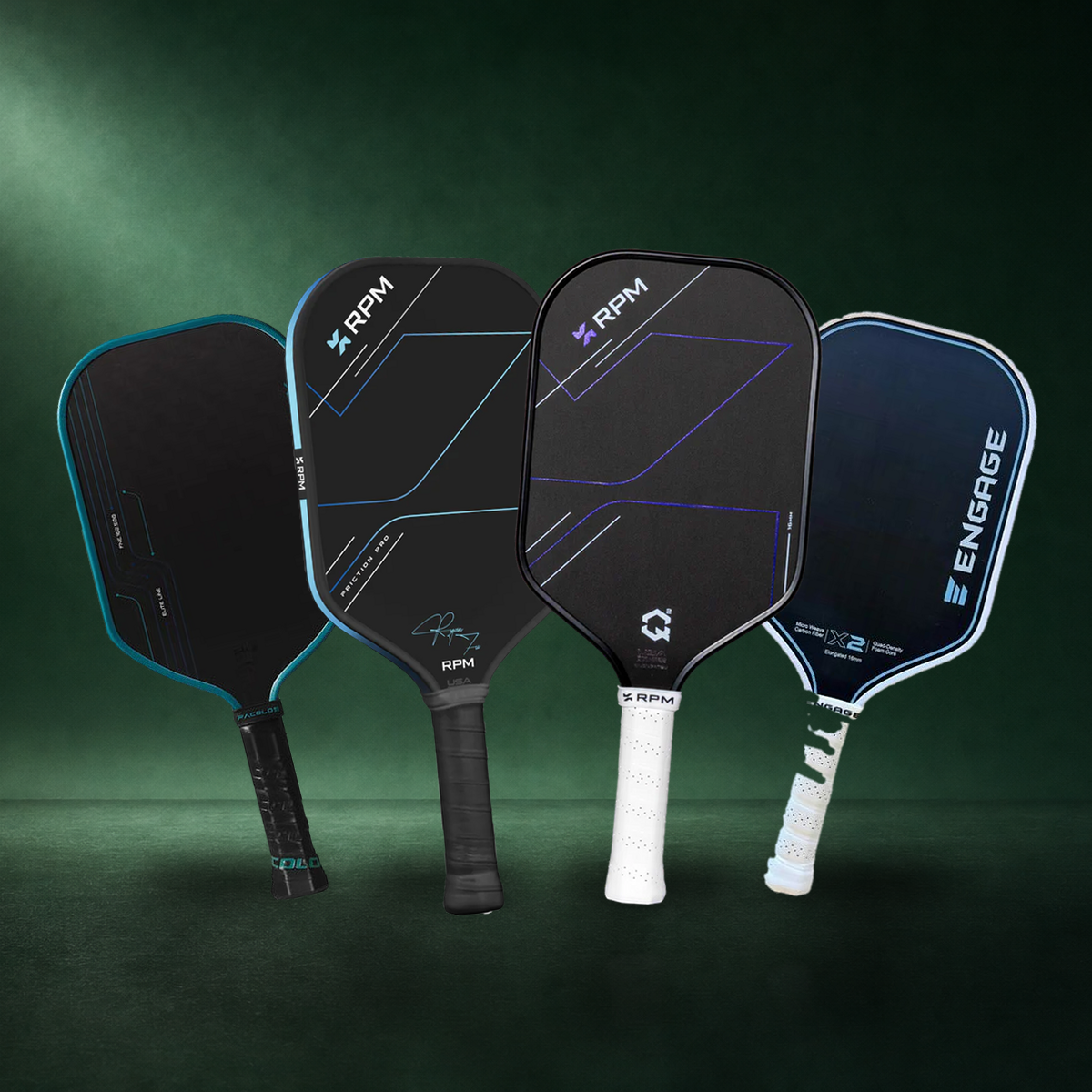
Gen 3 vs Gen 4 Pickleball Paddles: Honeycomb vs Full Foam, Explained
Walk into the shop today and you will hear two words thrown around more than any others: foam and honeycomb. Paddle makers have spent the last two years moving away from the honeycomb cores that defined Gen 3, towards cores made entirely of foam, and the marketing has got well ahead of the explaining. So here is the plain version, from a shop that has hit every one of these paddles.
We keep both generations on the wall at our Pickleball Parlour in Epping, and you are welcome to come and hit them back to back before you spend anything. Prices below are current at the time of writing.
Table of Contents
- What a Gen 3 Paddle Actually Is
- What Gen 4 Changed
- Gen 3 vs Gen 4, Side by Side
- The Gen 3 Paddles We Stock
- The Gen 4 Paddles We Stock
- How They Actually Play Differently
- Which One Should You Buy
- Worth Watching
- Frequently Asked Questions
- Come and Hit Both
- Try Before You Buy: Our Paddle Demo Program
What a Gen 3 Paddle Actually Is
A Gen 3 paddle is built around a honeycomb core, usually polymer or polypropylene, sandwiched between carbon faces and then thermoformed: the whole paddle is moulded as one unit rather than glued together, with foam injected around the inside walls to stiffen the edges. That construction is what gave Gen 3 its reputation for power and its noticeably firm, crisp response.
The honeycomb is the giveaway. If a paddle's spec sheet says polymer core, polypropylene core or honeycomb core, you are holding a Gen 3, whatever the marketing on the box says.
What Gen 4 Changed
Gen 4 throws the honeycomb out. Instead of a hollow cellular core, the paddle is filled with engineered foam, and usually more than one density of it: a softer foam towards the outside for dwell and feel, a firmer one deeper in for rebound and power. Engage call theirs a quad-density system in the X2, and RPM tune the foam densities individually through the Q2.
The practical goal is consistency. A honeycomb core is strongest where the cells are supported and weakest near the edges, which is why Gen 3 paddles have a sweet spot that falls away as you move off centre. A solid foam core is far more even, so a ball struck towards the tip or the edge comes off closer to how a middled one does.
Gen 3 vs Gen 4, Side by Side
The Gen 3 Paddles We Stock
Honeycomb cores, all confirmed on the manufacturer's own spec.


The Gen 4 Paddles We Stock
Full foam cores. Note the Six Zero Black Opal in this group: it is often assumed to be a honeycomb paddle, but Six Zero describe it as a G4 Aerospace solid foam core in a floating construction, which puts it on the Gen 4 side of this comparison.


How They Actually Play Differently
Power. Gen 4 hits harder, but the gap is smaller in the middle of the face than the marketing suggests. Where you really notice it is off centre, where a foam core keeps returning pace that a honeycomb core loses.
Dwell and spin. Foam compresses more and holds the ball a fraction longer. That extra dwell is why players report more spin and better touch on drops once they adjust. It also means the ball leaves later than you expect, which is the single most common complaint in the first week.
Feel. This is the honest dividing line. Gen 3 feels firm, immediate and connected. Gen 4 feels softer and slower to release. Plenty of good players prefer the Gen 3 feel and are not wrong to.
Break-in. Gen 3 plays the same on day one as on day fifty, until the core eventually softens. Foam paddles are widely reported to need a few sessions to settle before they show their best. If you demo a Gen 4 for twenty minutes and hate it, that is not a fair test.
Which One Should You Buy
Stay Gen 3 if you like a firm, predictable paddle, you are happy with your current power, or you are on a budget. A good Gen 3 at $275 will beat a mediocre foam paddle at $380 every time.
Go Gen 4 if you want more free power, you mis-hit more than you would like and want the extra forgiveness, or you play enough to be worth adapting to something new.
Do not buy Gen 4 because it is newer. A newer generation is not automatically a better paddle for your game. It is a different set of trade-offs.
Worth Watching
If you want to see these paddles hit before you decide, these are the clearest breakdowns we have found. They open on YouTube in a new tab. All credit to the original creators, we have linked reviewers and brand channels only, not other shops.
More to read and explore:
- Six Zero Pickleball on YouTube, Makers of the Black Opal foam core.
- Gen 3 vs Gen 4: Foam vs Honeycomb, Matt's Pickleball's written, data-backed comparison.
- Engage X2 technology page, Engage's own explainer on their quad-density foam.
Frequently Asked Questions
Is Gen 4 actually better than Gen 3? Not universally. Gen 4 gives more power off centre and a wider sweet spot. Gen 3 gives a firmer, more immediate feel that many players prefer. Better depends on your game.
How do I tell which generation a paddle is? Read the core description. Polymer, polypropylene or honeycomb means Gen 3. Full foam, solid foam or 100% foam means Gen 4.
Do foam paddles last longer? Manufacturers say yes, because there is no honeycomb to crush. The technology is new enough that long-term data in Australian conditions is still thin, so treat durability claims as claims for now.
Will a Gen 4 paddle improve my game straight away? Usually not. Expect a few sessions of over-hitting while you adjust to the longer dwell. Judge it after a month, not after one hit.
Can I try both before buying? Yes. Come to the Pickleball Parlour in Epping and hit a Gen 3 and a Gen 4 back to back. It is the fastest way to know which feel suits you, and it costs nothing.
Come and Hit Both
Reading about dwell time only gets you so far. We fit players to paddles every week, and the ones who end up happiest are almost always the ones who hit two or three paddles back to back before deciding. Bring your current paddle, we will put a Gen 3 and a Gen 4 in your hand, and you will know within ten minutes which side you are on.
Try Before You Buy: Our Paddle Demo Program
You do not have to guess. Melbourne players can take paddles away and hit them on their own courts before committing.
| The demo program | |
|---|---|
| Cost | $50 per paddle |
| How many | Up to 3 paddles at a time |
| How long | 3 days |
| Pick up & return | In person at Racquet World, Pickleball Parlour, Shop 4/59 Willandra Drive, Epping VIC 3076 |
| What you can try | Control, power and hybrid all-court paddles from the demo wall |
| Where you can play | Anywhere at your club, league night, or local courts across Melbourne |
Return them on time to avoid late fees. Find one you love and the team will order a brand new one in for you.