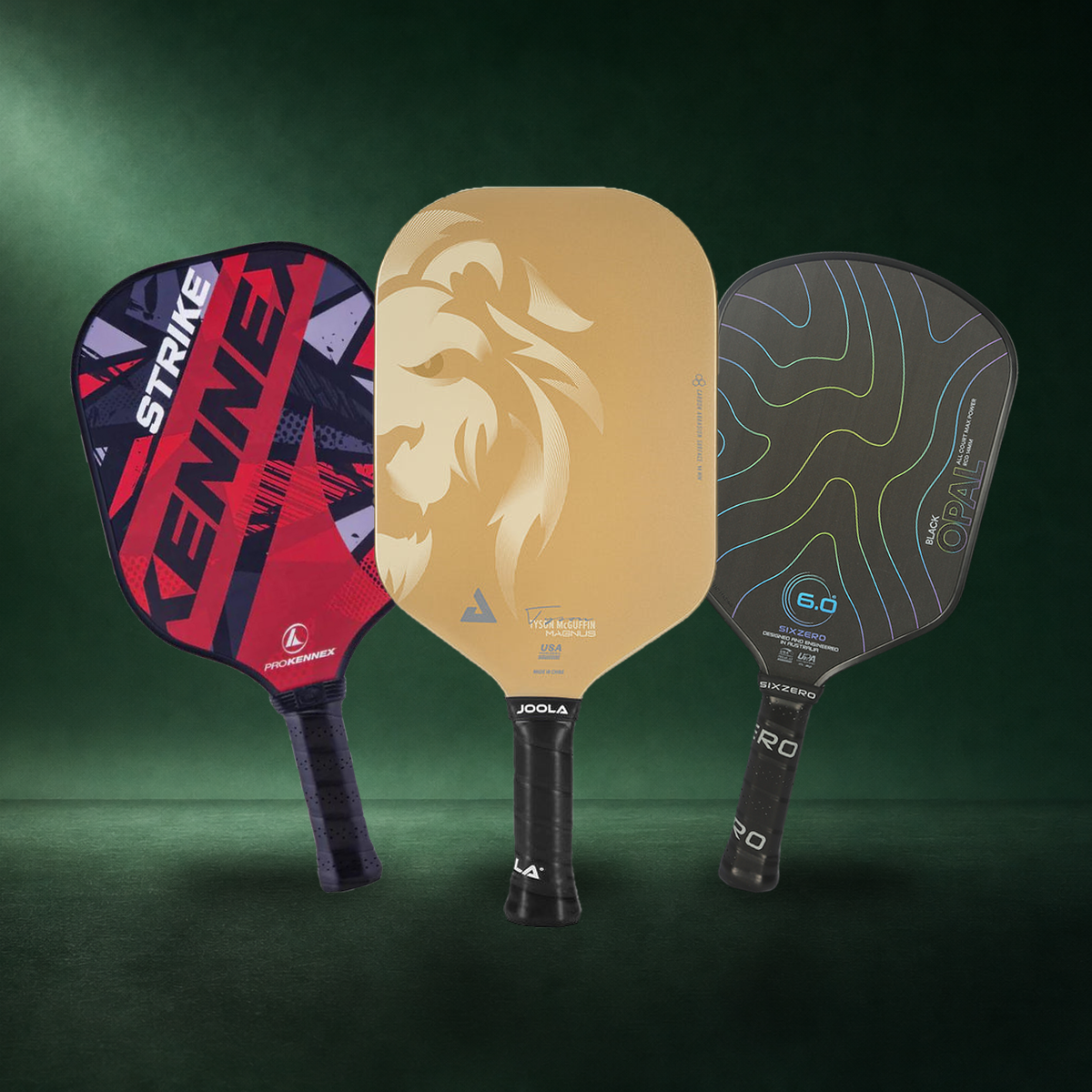
Your Complete Pickleball Paddle Weight Guide for Australian Players 2026
If you have ever stood at our counter in Epping turning two paddles over in your hands, wondering why one feels like a feather and the other feels like a frying pan, you already understand the most important spec on any pickleball paddle: weight. We fit players at the Pickleball Parlour every week, and weight is the single thing that changes a paddle's feel more than colour, brand, or even core thickness. Get it right and the paddle disappears in your hand. Get it wrong and you will fight it on every shot, or worse, end up nursing a sore elbow after a few sessions.
This guide is organised the way we actually fit players: by skill level first, then weight within it. Beginner is up to $169, intermediate is $170 to $299, and advanced is $300 and up. Every paddle below shows its published weight, given as a range wherever the maker quotes one, and every one of them is in stock right now.
Table of Contents
- Why Paddle Weight Matters
- Beginner: Up to $169
- Intermediate: $170 to $299
- Advanced: $300 and up
- Paddle Comparison Table
- Weight, Swing Weight and Balance
- Weight and Arm or Elbow Comfort
- How to Adjust Your Paddle's Weight
- Frequently Asked Questions
- Getting Fitted
- Try Before You Buy: Our Paddle Demo Program
- More reading
Why Paddle Weight Matters
Most paddles sold in Australia sit somewhere between 7.4 and 8.3 oz. That sounds like a tiny range, and on the kitchen scale it is, but the difference of half an ounce changes how the paddle behaves through every phase of a point. Weight drives three things at once: how fast you can move the paddle, how much power it generates for a given swing, and how stable it stays when a hard ball hits it off centre.
A lighter paddle moves quicker. At the kitchen line, where hands battles are won and lost in fractions of a second, that extra hand speed lets you reset, block, and counter before your opponent has reloaded. The trade-off is that you have to supply more of the power yourself, because there is less mass behind the ball.
A heavier paddle does the opposite. It carries more mass into the ball, so the same swing produces more pace and the head holds its line better when a hard drive catches the edge of the face. The cost is slower hands and more load on your arm over a long session.
Neither is better. The right weight is the one that matches your body, your style, and how often you play, which is why the sections below start with where you are as a player rather than with a number on a scale.
Beginner: Up to $169
Your first paddle. These are honest, playable paddles that will not hold a new player back, and they leave you room to work out what you actually like before spending more.
On weight, the beginner wall sits in a narrow band from about 7.6 oz to 7.9 oz. That is deliberate. A paddle in the high sevens is light enough that a new player can still swing it cleanly at the end of a long session, but not so light that every hard drive knocks it off line. None of these will teach you a bad habit, and none of them will hurt your arm while you are learning.


Intermediate: $170 to $299
You have found your grip, you are driving the ball with intent, and the gaps in your game are yours rather than the paddle's. This is where the build quality steps up without going pro-level.
This is the widest weight spread in the guide, from 7.4 oz up to 8.3 oz, and that is the point. By now you know whether you are a hands player or a banger, so you can pick weight to suit rather than take the safe middle. Go lighter for speed at the kitchen line, heavier for stability and free power off the drive.


Advanced: $300 and up
Thermoformed and full-foam builds, premium carbon faces, and the paddles our competitive players actually use. At this level you are buying a specific feel, so hitting before you buy matters most.
At this level the static weights cluster tightly between 7.9 oz and 8.3 oz, so the number on the scale stops being the deciding factor. What separates these paddles is where the mass sits and how the core behaves at impact, which is why two 8.0 oz paddles here can feel nothing alike. This is the tier where a demo is worth more than any spec sheet.


Paddle Comparison Table
Every paddle in this guide, grouped by skill tier and sorted by price, with the maker's published weight beside each one.
| Paddle | Skill tier | Weight | Price | ||
|---|---|---|---|---|---|
 |
JOOLA Andre Agassi Champion (12mm) | Beginner | 7.8 oz | $94.95 | View Paddle Now |
 |
JOOLA Steffi Graf Champion (12mm) | Beginner | 7.8 oz | $94.95 | View Paddle Now |
 |
Pro Kennex Strike | Beginner | 215 g (about 7.6 oz) | $99 | View Paddle Now |
 |
Six Zero Quartz | Beginner | 7.9 oz | $99 | View Paddle Now |
 |
JOOLA Steffi Graff Edge (16mm) | Beginner | 7.8 oz | $159 | View Paddle Now |
 |
Pro Kennex Kinetic Pro Flight (Navy) | Intermediate | 7.4 oz | $199 | View Paddle Now |
 |
Pro Kennex Kinetic Pro Spin | Intermediate | 7.6 oz | $199 | View Paddle Now |
 |
JOOLA Tyson McGuffin Magnus CAS (14mm) | Intermediate | 7.9 oz | $209.95 | View Paddle Now |
 |
Six Zero Black Diamond (14mm) | Intermediate | 8.1 oz | $225 | View Paddle Now |
 |
Six Zero Coral (16mm) Widebody | Intermediate | 8.0 to 8.3 oz | $275 | View Paddle Now |
 |
Engage Pursuit Alpha (16mm) | Advanced | 8.0 oz | $309 | View Paddle Now |
 |
Sypik Ultimate Triton 3 (16mm) | Advanced | 8.0 oz (226.79 g) | $319 | View Paddle Now |
 |
Six Zero Black Opal (14mm) | Advanced | 8.0 to 8.3 oz | $350 | View Paddle Now |
 |
RPM Friction Pro - Elongated (16mm) | Advanced | 7.9 oz (223.96 g) | $369 | View Paddle Now |
 |
JOOLA Andre Agassi Pro IV (16mm) | Advanced | 8.1 oz | $379 | View Paddle Now |
Weight, Swing Weight and Balance
Here is the thing the spec sheet does not always tell you: the number on the scale is the static weight, but what your arm actually feels through a swing is the swing weight, and those are not the same. Swing weight describes how heavy the paddle feels in motion, and it depends on where the mass sits relative to your hand.
Two paddles can weigh the same 8.0 oz on the scale, yet one feels noticeably heavier to swing because more of its mass is up in the head. That is balance at work. A head-heavy paddle delivers more power and plough-through but feels slower and more tiring. A handle-heavy, or head-light, paddle feels quicker and more nimble even at the same static weight, which is why some players happily swing a heavier paddle that is balanced towards the handle.
Elongated shapes, like the RPM Friction Pro, naturally push a little more mass away from your hand, so they can feel livelier on the drive even when the static weight is modest. This is exactly why we get you swinging paddles in the shop rather than just reading numbers off a label. Two paddles with the same weight can play completely differently, and your arm is the only honest judge.
Weight and Arm or Elbow Comfort
Pickleball elbow is real, and we see it walk through the door regularly. The repetitive impact of paddle on ball travels straight up your forearm, and a heavier paddle, a stiffer core, or a vibration-prone build all add to the load. If you are playing several times a week, or you already have a touchy elbow from tennis or work, weight is not just a performance decision, it is a comfort and longevity decision.
As a rule, a lighter paddle with a softer 16mm core is the gentlest on your arm, because there is less mass to swing and decelerate and more cushioning at impact. That is part of why we point players with sore elbows towards the lighter end of the wall, like the 7.4 oz Pro Kennex Kinetic Pro Flight. A thicker core also tends to dampen vibration better than a thin one, so it is not just the weight that matters but the whole package. If comfort is your priority, tell us at the fitting and we will steer you accordingly.
How to Adjust Your Paddle's Weight
One of the best-kept secrets in pickleball is that weight is not fixed. You can tune a paddle to suit you, often turning a paddle you almost love into one that is exactly right. The two main tools are lead tape and overgrips, and they work at opposite ends of the paddle.
The clever move is combining them. If you love a light paddle but want more stability against hard shots, add a touch of lead at 3 and 9 and balance it with an overgrip, and you get a more solid paddle that still swings quick. If you find a heavier paddle slightly too head-heavy, an extra overgrip can bring the balance back towards your hand. Bring your paddle into the Pickleball Parlour and we will help you dial it in rather than guessing at home.
Frequently Asked Questions
What is the best paddle weight for a beginner?
Most beginners are best served somewhere between 7.6 and 7.9 oz, which is exactly where our beginner tier sits. The JOOLA Steffi Graff Edge at 7.8 oz is the one we hand over most often, because the 16mm core softens impact while the weight stays easy to swing for a full session. From there it is simple to go lighter or heavier once your game develops.
Does a heavier paddle really give more power?
Yes, all else being equal. More mass behind the ball produces more pace for the same swing, and a heavier paddle is also more stable against hard incoming shots. The trade-offs are slower hands at the net and more arm fatigue over a long session, so it is a balance between the extra power and what your hands and arm can comfortably handle.
Should advanced players use heavier paddles?
Not necessarily. Our advanced tier runs from 7.9 oz to 8.3 oz, which is barely wider than the beginner tier, and one of the lightest paddles in the whole guide sits in it. What changes at this level is not raw weight but where the mass is placed and how the core behaves at impact. Skill level sets your budget and your build quality. Your style still sets your weight.
Will a lighter paddle help my tennis elbow?
Often, yes. A lighter paddle with a softer, thicker 16mm core means there is less mass to swing and decelerate and more cushioning at impact, which reduces the load travelling up your forearm. It is not a cure, and grip size and technique matter too, but for many players moving lighter makes a real difference. Come in and we will talk through the full picture at a fitting.
Can I add weight to a paddle later if I want more power?
Absolutely. Lead tape lets you add weight to the head or edges to gain power and stability, and an overgrip adds a little weight in the handle to keep the paddle quick. This is why a lot of players buy slightly lighter than they think they need, then tune up. It is far easier to add weight than to take it away.
Why do some paddles show a weight range instead of one figure?
Because that is what the maker publishes. Six Zero quote their Coral and Black Opal at 8.0 to 8.3 oz, and we show that range rather than picking a number in the middle, because hand-built paddles genuinely vary from unit to unit. Where a maker quotes grams only, as Pro Kennex do with the Strike at 215 g, we show the gram figure and the conversion.
Getting Fitted
Paddle weight is the lever that changes feel more than anything else, but the number on the scale only tells part of the story. Swing weight, balance, core thickness, and your own arm all feed into the decision, and the only way to know for sure is to put a few paddles in your hand and hit some balls. That is what we are here for.
You can browse the full range online and we ship Australia-wide, so wherever you play you can get the right paddle delivered. If you are anywhere near Melbourne though, come and see us in Epping. The free in-store paddle fitting at the Pickleball Parlour takes the guesswork out of it: we will get you swinging across the weight bands, talk through your style and any arm concerns, and send you home with a paddle that genuinely fits. No hype, just the right paddle for your game.
Try Before You Buy: Our Paddle Demo Program
You do not have to guess. Melbourne players can take paddles away and hit them on their own courts before committing.
| The demo program | |
|---|---|
| Cost | $50 per paddle |
| How many | Up to 3 paddles at a time |
| How long | 3 days |
| Pick up & return | In person at Racquet World, Pickleball Parlour, Shop 4/59 Willandra Drive, Epping VIC 3076 |
| What you can try | Control, power and hybrid all-court paddles from the demo wall |
| Where you can play | Anywhere at your club, league night, or local courts across Melbourne |
Return them on time to avoid late fees. Find one you love and the team will order a brand new one in for you.
Read more about the demo program →